I recently read Eat That Frog, a personal productivity guide by Brian Tracy.
Eat That Frog is a personal productivity book full of tips.
It’s an interesting book. There are 21 easy simple tips which work together, I especially like the format because it’s easy to dip in and out of. Some of the suggestions are very very good. Putting technology aside, breaking big goals into smaller steps, and making sure highest priority tasks are identified.
Brian Tracy makes a huge point of picking up the most important task for the day at the very beginning. Personally I’m not a fan of this approach (as long as it’s identified and gets done). But I can see the wisdom in it.
Would I recommend Eat That Frog? If you’ve not ready many personal productivity books before and are looking for a few tips to help you organise things and deliver – sure, there’s probably quite a lot in there you’ll like. If you’re not new to the genre then you probably won’t get a huge amount of new advice from the book.
So you’ve been through the interview process, had an offer, and accepted the role. Time has passed and you’re getting nervous. What will your first day be like? What should you expect and what should you do?
The most important thing to remember about your first day is that there won’t be any huge expectations of you. No one is expecting you to sit down and write features and fix urgent bugs straight away. Focus on the people, get to know your Line Manager and your team. Find out where you will sit or whether the company has a hotdesking policy. Take a notebook and use it because you will be overwhelmed.
Your first day will be exhausting and overwhelming, don’t expect too much. Photo by Andrea Piacquadio on Pexels.com
Your top priority for your first day is to get to know people, to make a good impression by being polite and friendly to everyone you meet and to ask lots of questions. It’s quite likely you’ll be bombarded by so many pieces of information you’ll start to lose track so don’t forget that notebook! Remember, people’s names are more important than every detail they’re telling you – you can always ask them for clarification later, but only if you remember who to ask.
Many companies have a formal HR training on the first day which can last anywhere from half an hour to a full week depending on the company and the role. These often run through basic Health and Safety and in some cases legal/data protection rules. These aren’t the most exciting sessions you’ll attend during your time at the company but they are important. If you’re starting with other people you’ll likely take part in the same training as them, say hello and ask a few questions. I still remember many of the people I attended inductions with with even though we’re scattered across the departments (and in some case companies).
You’ll also likely be given your computer and be expected to set it up. Focus on things like email, calendars, and whatever IM program the company is using. Over time you will also need to connect to your team’s source control repositories and install your development tools but I’d often recommend waiting until you’re guided on this. It can be quite easy to get it wrong which can cause more challenges than simply asking for some support. Be careful about installing software you’re not authorised to do so – always check with your manager before installing something if you’re not sure if it’s allowed on work hardware.
Make sure you know what to do if you’re sick on your second day (I hope you won’t be) but it help to be prepared. It often helps to get your manager’s phone number if you don’t already have it.
It’s fair to say that first days can be a little overwhelming so wanting to get a second opinion I asked a colleague of mine, Lizzie who joined our department last year as a junior engineer. She said
You won’t pick up everything straight away – you won’t understand business processes, won’t remember everyone’s name or know where all of the toilets are in the building etc on the first day – so don’t stress. Take in as much information as you can and be enthusiastic.
Lizzie
Most all all try to relax. You’ve worked very hard to get this job and you should be very proud you’re there. Focus on building relationships with the people in your team. Be humble and be willing to learn and take advice. Because when you need help, and you will need it, it will be those people who will support you.
There are very few things as rewarding as working as part of a great team. Photo by fauxels on Pexels.com
What are you most nervous about when you start at a new company? What do you wish you’d known before you started? Drop me a message on Twitter or post your questions below.
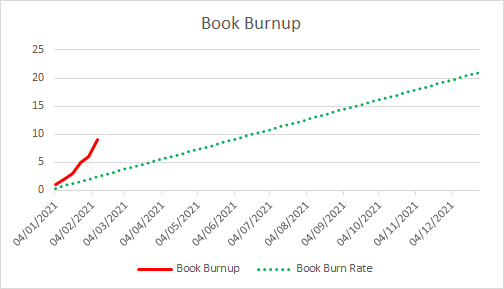
I like to think of myself as prolific reader. I set myself the goal of twenty one books this year (very conservative for me because I’m not getting lunchtimes in the office to crack open a book) however at the time of writing I’m already up to 9 books and am expecting to have another two finished before the end of the week.
If you’ve read my post on Personal KPIs you’ll have seen that I track my goals to provide visual encouragement, but also an early warning if I’m running behind. Here’s my reading graph:
My reading progress for 2021. The green line shows what I need to consume to hit my goal of 21 books this year. The red shows my actually weekly progress.
I believe reading is one of the most important habits any adult can develop. There are millions of books out there with valuable information and contrasting ideas which will stretch you and force you to make a decision. There are books on every conceivable subject and (just in case you needed any more motivation) they’re a fantastic way to unplug and relax.
However, before I go any further let me tell you a joke.
One day a chicken walks into a library, a little surprised the librarian asks how he can help and the chicken replies (perhaps not unexpectedly) "Book!". The librarian passes a widely recommended book which had recently been returned and passes it to the chicken who struts off. The following day the chicken returns and says to the librarian "Book book!" Deciding to humour the chicken the librarian passes the chicken two books. The third day the chicken returned once again and went up to the librarian. Ready this time when the chicken said "Book, book, book..." the librarian hands the chicken three books. Curious now the librarian follows the visitor, determined to find out what was going on and where the chicken was going. As they rounded the corner to a quiet part of the library the chicken strode up to a frog and placed the books on the table. The frog sighed, looked at the books and said "Read it, Read it, Read it..."
Maybe it works better when you read it out loud?
The point of the joke is this. Don’t be a frog! Your job is not simply to read books and say “Read It” over and over again. Reading isn’t about bragging, it’s about expanding your knowledge. Always make notes, scribble some ideas you have while you’re reading the books, non-fiction ones at least. Otherwise you’re simply being a frog. The authors of the books are trying to convey information to you – try to take at least one action from each book you read and use it.
Back to the orginal question. How to absorb so many books, especially given a full time job and a hectic lockdown home time?
The answer is two fold. Audiobooks and Playback speed.
A lot of people have a snobbery around audiobooks. In the same way many people say that reading off an e-reader isn’t as good as a real book. However, I’d ask you – if you had the choice of waiting until you could pick up a paper book or listening to a pre-recorded version while you’re doing the washing up or driving somewhere which would you rather do? I do read physical books and on my kindle too, but the vast majority are audiobooks. There are many providers but personally I’m a huge fan of audible, if you don’t like the book you can simply return it. You can’t ask much fairer than that!
The second way of improving the rate at which you listen. My wife laughs at me because she says I listen to everything at “hamster speed” which I suppose I do. The first time you try to speed up the playback it is really hard to follow what’s going on but, you’ll be surprised at how quickly you catch up. Try adding going to 1.2x and then a few days later 1.4x and so on. You’ll be amazed how quickly you can get up to 2.0x and even 2.5x. For quite a while I resisted this, I didn’t want to rush my absorbtion of the books or my enjoyment of the fiction. However, honestly, if I listen to something now at 1.0x times it sounds like the narrator is drunk, speaking slowly, and slurring.
Do you listen to audiobooks? Do you use audible or another supplier? What speeds do you listen to and why? Comment below and don’t forget to follow the blog for future updates.
As you many have noticed I’ve been trying hard to post much more regularly. I’ve also been running my Junior Developer series.
But I’m worried that the blog is rather disjointed with lots of different topics.
Book Reviews
Junior Developers
Agile and DevOps Topics
Various talks/writing topics
What I’d like from you is a little indication of what you’re enjoying reading and what you’re not. Obviously the intent is to write more of what my followers are enjoying.
Please drop me a message or comment below to let me know!
An unfortunate part of any interview process is rejection. Unless you’re very lucky you’re going to be turned away from more opportunities than you’re offered. Especially when you’re trying to make a particuarly large leap – such as the one from student to professional.
In an attempt to gather some good advice for people who have been rejected from a role I reached out to my LinkedIn network. Not because of any lack of experience on my part but because there are probably people out there who handle it better than I do (seriously the sulking isn’t a good look for anyone).
If you’re on LinkedIn (and if you’re not I strongly recommend you join) then have a read of the question here. However, I wanted to capture some of the advice I got in this post.
Ask for feedback, one of the most important parts of a successful DevOps culture is getting, understanding and implementing feedback into everything we do.
Connect with people, by making connections in the industry we can gain more insight into what goes on in the company you were rejected by.
Apply again, if you can demonstrate you have improved why wouldn’t a potential employer want to interview you again
Kurt
I used to work with Kurt and he’s a good guy. He’s also a DevOps evangalist and hired lots of people himself. I think this is great advice, we’re in an industry where we gather feedback and respond accordingly. Why not do this with your own career? Listen to what the feedback was from the company, look at any weaknesses they highlight and use them to drive your next stage of learning. Kurt wasn’t the only person to stress the importance of taking feedback on board.
A lot of what we do is iterative: try to analyse your performance and work out where you didn’t fully elaborate on something you may feel was obvious or forget to emphasise a key challenge or innovative solution. Assume that people will understand the language you use but not necessarily the details of a technology or situation.
Practice will make talking about yourself, to new people and about your achievements and approach easier.
Nick
Being rejected for a role is never easy. However, it can be extremely useful. Photo by Andrew Neel on Pexels.com
Don’t take it personally. Mope for a day, dust yourself off and don’t get discouraged. Work on any areas you got the negative feedback on (appreciate you don’t always get any). It might just simply be that another candidate just pipped you to the post. If there is only one role, someone is going to lose out and a client will have to nit pick in order to select someone. The worst part of my job is declining someone after an interview, especially if I know they really want it.
I’ve worked with Simone before and she really knows her stuff. She also understands that sometimes it can be very difficult to seperate clients and sometimes it comes down to things like team fit and how they performed on a single question in the interview. Not every rejection is a huge blow, you never know just how close you were to getting that offer. Don’t get disheartened!
Rejection is rubbish, there’s no two ways about it. But one person saying no does not mean you’re at the end of your journey. Keep going and keep learning! Photo by Alex Green on Pexels.com
You can drive yourself nuts worrying what you did wrong and the chances are it wasn’t anything that, on a different day, would have mattered.
Michael
Philip echoed this sentiment. Sometimes it’s the smallest things which seperate the successful candidate and the ones who were rejected. Don’t assume that you were nowhere near because you may have very well been a close second.
It’s a bit like asking someone on a date – not everyone is going to say yes, and often they’ll have reasons for doing so that range far beyond “you’re not good enough” or “we don’t like you”.
It can just mean you’re not exactly what the company is looking for at the time – they may be looking for something slightly different next time.
Philip
However, I’ll leave you with an optimistic idea from Nick. He says:
Being rejected from one role gives you the opportunity to accept another that may be better. You may miss out on a job that you thought you would love and end up with one you actually do
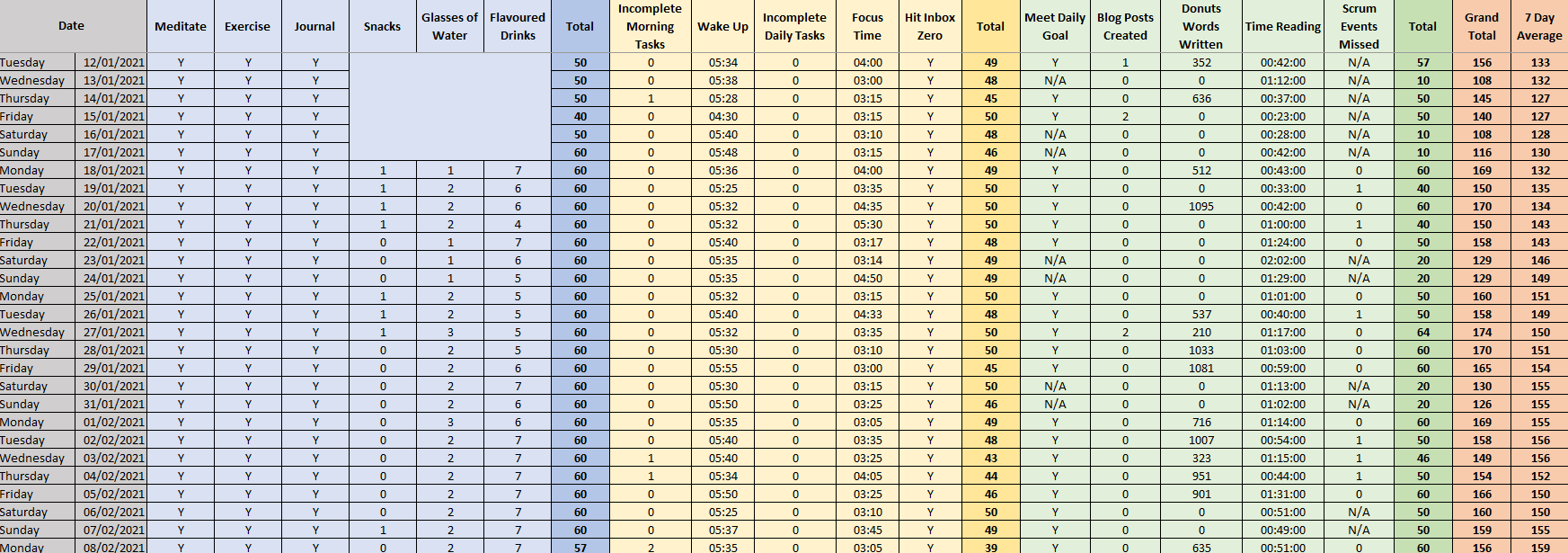
I’ve spent a lot time reading about daily habits and routines recently. Both Atomic Habits and Routine Machine strongly advocate spending a small amount of time each day to contribute towards your larger goals. I like the idea, after all as an agile geek I fully support the importance of transparency. Otherwise, how can we expect to inspect and adapt?
I mentioned some of my 2021 goals recently. Some of these are perfect examples where I must display if not daily, then weekly behaviour if I’m going to hit them. Donuts and Dragons isn’t going to write itself, I need to put words on the page day after day. My reading goal isn’t magically going to happen, I need to spend a little time each morning listening to audible or perhaps reading in the evening.
To this end I’m experimenting with a Personal KPI spreadsheet. In this spreadsheet I’m tracking various KPIs such as “Donuts Words Written” and “Time Reading”. I’m also tracking various KPIs around health and daily routine. Am I hitting Inbox Zero every day?
My spreadsheet gives me a daily score, however most beneficial I believe will be the weekly rolling averages. I don’t have to write a blog post every day, however I aim to write at least three a week. I don’t have to listen to my audiobooks every morning but I do want to make sure I’m listening for an appropriate time each week to hit my quarterly targets.
Am I on track to hit my personal goals this year? Photo by Lukas on Pexels.com
It may seem like overkill, but I’m hoping that this mechanism will help me stay on track for some of the big goals I’ve set myself this year.
What do you think? Is this overly complex for personal goals? Do you have a similar mechanism and how did it work for you? Let me know in the comments below!
I’ve written quite a lot over the last few weeks about interviewing and recruitment. Howevever there are a couple of other recruitment techniques I want to mention in an effort to prepare you.
The first of these is assessment centres.
Recruitment takes a lot of time and effort. When you’re recruiting a pool of people, for example a number of junior engineers all at once or perhaps an entire team. It becomes more efficient to combine these into a single recruitment event rather than conducting individual interviews with each candidate.
Assessment Centres are when multiple candidates are invited in together. Photo by ThisIsEngineering on Pexels.com
Aside from the time saving opportunities this also gives the assessors a few opportunities such as seeing how you can undertake a group task and how you interact with people througout the day. Far from being daunting these can be a lot of fun and often give you much more chance to talk to existing members of staff and compare notes with other candidates.
Many people see the other candidates in their assessment centres as the competition, and this is true to a point. After all, there are often only a limited number of vacancies available. However, you should be careful of this mindset. One of the reasons for putting candidates together is to see how they work together and engage with potential peers. If you’re in super competitive mode you’re not going to demonstrate your team work skills to their full potential.
Assessment Centres can take many forms and have many different components. When I’ve run assessment centres we’ve done a presentation to the candidates to tell them about the company and the role, tours of the office, interviews, a written test, a group activity, and a meet and greet where we’ve invited existing employees down to meet the candidates. Try to relax and enjoy the experience as much as possible. It’s a long and exhausting day – but you’ll get a lot out of it.
Another type of interview which has exploded since Covid-19 started rampaging across the globe is the video call interview.
Remote interviews have become extremely common since the global pandemic. Photo by Vanessa Garcia on Pexels.com
With isolation and social distancing the norm today it can be extremely difficult (and unwise) to meet candidates face to face. Because of this many companies are doing video calls to interview candidates.
The rules for a video call are not that different to a regular interview however I will run through a few of the basics for you.
Always arrive on time, test technology beforehand if possible and make sure you have a contact number for the company should IT let you down.
Consider what you’re wearing. A suit and tie is probably not essential for an interview at home but maybe a football shirt for your favourite team isn’t the best choice either?
Consider your background. Imagine you are being interviewed by the BBC (other news agencies are available). Make sure your background is clean and tidy, there isn’t a lot of noice, and you’re well lit.
Consider where your camera is. Many people have cameras on a second monitor but remember this is a conversation. You other person wants to feel like you’re looking at them, not staring off distracted in the distance (even if that’s where your screen is). Try to put the camera as close to the interviewer as possible and look into the camera on occasion. For more tips on Non-Verbal Communication remotely check out this post.
And that’s about it. Many of the basics for in person interviewing still apply, but don’t be surprised if you’re not invited to more and more remote interviews as time goes by.
Have you been to an assessment centre or had a video interview? What were your experiences? Drop me a message or comment below and don’t forget to subscribe so you don’t miss the rest of the series.
After all the positive feedback I recieved writing Code Black last year I’ve been working on something else.
For those who don’t know Code Black is a business parable novel for DevOps techniques. In other words it’s a story, about a team at a failing IT company who embrace modern software development techniques to produce higher quality software in a much more efficient way.
Writing a book is not easy, it’s never turned into a best seller (although who knows, this post may go viral!) but I enjoyed the process and I learned a lot putting it together.
Deciding to push myself once again I’m dusting off my keyboard and writing Donuts and Dragons.
Once again Donuts and Dragons is a story, this time about Megan who joins a team who are working to develop the next best selling game. Instead of DevOps I’m focusing on agile techniques.
I’m publishing the story on LeanPub, the site (in a very agile manner) encourages you to publish early and often. The word count is going up, slowly and steadily as a first draft. As the story is very much in the early stages I’m not charging for anyone who wants to read it and provide feedback.
As I mentioned in my recent goals post, I’m hoping to finish the book in 2021. To do this I’m hoping to have the first draft completed by June and then I’ll have plenty of time to proof read and listen to your feedback. Why not have a look at what I’ve got so far? I’d love to hear your feedback!
I’ve written a lot over the last few weeks about preparing and applying for roles, especially for the junior and aspiring developers who are entering the market for the first time. However, what I’ve not really covered is whether or not you should accept the role you’re offered.
Whether or not to accept a role may not be a straightforward decision. Photo by Armin Rimoldi on Pexels.com
There’s always a balance to be struck when that first offer comes. Ideally you want to have a few to choose between. However, personal circumstances may mean you really do need to take the first offer you get but I want to talk a little about what to look for when deciding whether to accept an offer or not.
Pay, obviously is a factor. If you are presented with one offer that is significantly more than another or if the increased cost of the commute would mean you can’t actually afford to take on a role then you should never feel pressured into it. There is sometimes room for negociation here (see my previous post on negociating salary), but it’s always better to set a clear expectation up front than to have a disappointingly low offer.
The next aspect, especially for people new to the profession is the confidence they have in the team, the company, and the hiring manager. For many young people entering a full time job, especially one as technically challenging as software development is one of the biggest challenges they’ll have faced so far. But it isn’t one they face alone. The responsibility for training and onboarding any new employee lies as much with the manager, team, and company as it does with the individual. No one should be thrown at a job, especially a junior one and expected to “get on with it”. They’re going to need help. What you need to establish during your application process is whether you have confidence that the company have the willingnenss and ability to invest in your over the first few years of your career.
Is your hiring manager someone you feel you could go to if you were struggling or worried about your performance? Have they discussed how they plan to train you? I’m encouraged when someone asks what support there is at the company to help and learn, it shows self awareness. It’s not a sign that the person is too inexperienced and I shouldn’t hire them!
Consider asking questions like:
Does the company have much experience hiring junior developers straight out of university?
What sort of training plan do you have in place for new starters?
When do you anticipate I’ll be a fully productive member of the team?
Will I be assigned a mentor for when I get help?
When you’re being interviewed you should always be asking yourself whether the people interviewing you are people you trust to place the next few years of your career with.
Do you have any suggestions of red flags you should watch for when deciding on a company? What advice would you give for someone looking for the right fit? Post in the commends below and don’t forget to follow the blog so you don’t miss out on the next post.
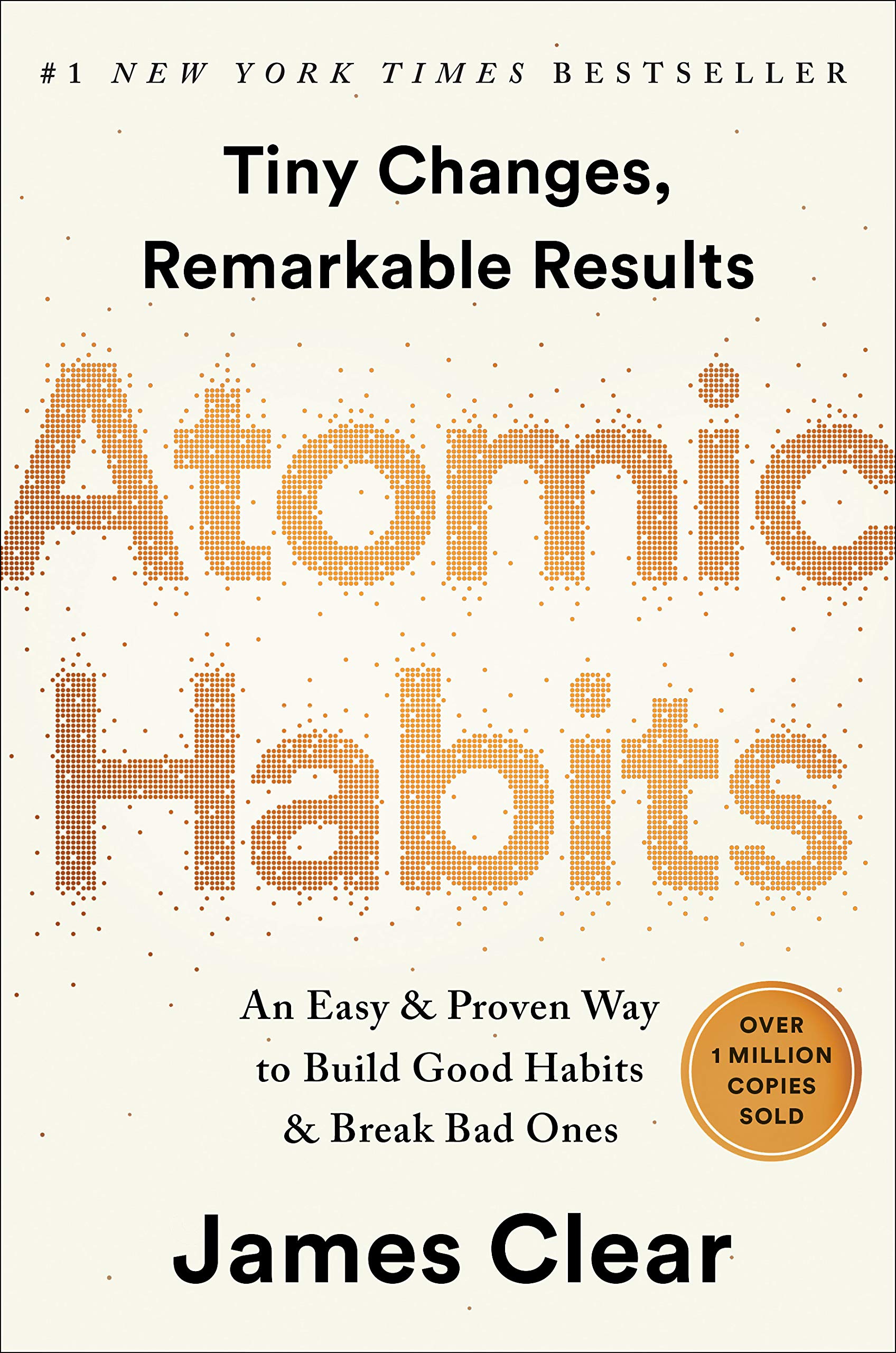
Atomic Habits is a different book, more granular and if you’re interested in personal productivity then it’s a good read.
In the book James first sells the value of habits, discussing how small incremental changes each day are vital to achieving major results. Then he moves on to deconstruct the various parts of a habit including Cue, Crave, Response, Satisfaction. In other words something triggers our habit, then we develop a craving for something, we act in a pre-trained way to satisfy that craving, and gain satisfaction.
In a positive habit this may look like:
Every morning when I get up
I want to clear my head
So I meditate
And feel better afterwards
However, in a negative habit this could be:
When I’m bored
I crave entertainment
So I open social media
Which entertains me
James then talks about how to hack these habits by eliminating cues, changing rewards, and building commitments so the habits you do want to form stick and the ones you don’t are broken. It’s good, sensible stuff.
As I mentioned above there’s a LOT of crossover with Routine Machine, however Atomic Habits goes far more into the techniques for forming and breaking daily habits. In his book Mark Lamberton focuses on how to point these in the direction to achieve big things. I see the two books as a very valuable pairing because, if I was to raise a criticism with Atomic Habits there’s not enough pagespace dedicated to creating structure so habits point you towards your longer term goals (although the idea of reinforcing identity is a very good one – see “Habit 2” of 7 Habits of Highly Effective People).
I listed my 2021 goals in an earlier post and I think there’s lots that can help me here. Specifically I want to work on the cues and immediate satisfaction of my reading, writing, and blogging. Perhaps putting together a calendar so it’s very obvious which days/weeks I’ve missed.
Have you read Atomic Habits? What did you think of it and have you encorporated any of it’s advice into your daily routines?











 dotdotdev.com