
I’ve been looking forward to writing this post for a long time. I’m pleased to announce that my new book Backlog to Breakthrough is now complete and available to buy.
I set myself a goal in Q3 of 2024 to “write a book about Scrum.” I hadn’t written anything for a while, and I wanted to use ChatGPT to see what all the fuss was about. I really enjoyed writing my previous book Donuts and Dragons, but I never felt I truly captured what complexity actually was—or why we needed Scrum to help address it.
Overall, the writing process went quite well, even if working with an AI was sometimes like arguing with a grumpy toddler. I managed to get the large pieces of the story in place within a couple of months.
Then I put the book down.
This was quite deliberate. When you spend so long going over the same chapters and pieces over and over, you can find yourself a little blind to the words on the page. So I set it aside until the start of this year and gave myself permission to forget about it. This meant that when I returned to it, I could spot the mistakes and problems I’d been too close to notice the first time.
If you’re interested, some of the main problems I addressed were:
- The issue of how to handle Jessica’s specialised skillset was never properly resolved.
- Jamie promised to go and talk to his CTO, and then completely failed to mention it again.
- The stakeholders came into the Sprint Review far too late—and when they did, they somehow appeared in Sprint Planning instead.
I worked through these problems, tweaking the story so it still worked while reinforcing the messages I was trying to communicate. Why do we have a Sprint Review? Why do we want a wide range of invested stakeholders? Believe me, afterwards I was wishing I’d just decided to write a good old fantasy novel instead.
Anyway, that brings me to about a week ago, when I finally finished another read-through. This time I was much happier—the story seemed to flow better, and while there were the odd typos and issues to resolve, there wasn’t anything that couldn’t be fixed quickly.
The beauty of using Leanpub is that it’s trivial to make these changes as you go. At one point, I think I was uploading almost daily so people could see the newer chapters as I was writing them. Good fun. Very agile!
Which brings me to the final point I wanted to make about AI. It was a lot of fun to use ChatGPT for this book. When you’re brainstorming characters and dialogue, it can be a very helpful writing buddy. What it cannot do is write a novel—especially one about Scrum. There are a few reasons for this.
First, its Scrum knowledge is limited. The model is obviously trained on huge datasets—and let’s just say some of the information out there about Scrum isn’t great. If I got £1 for every time I had to remove the phrase “Scrum ceremony”… well, I’d probably make more than I’m actually going to earn from the book itself.
It also has a really bad habit of adding rousing and determined lines at the end of each chapter. The number of times Jamie left the room with a “sense of determination and purpose”… Anyway, I tried to cut out as many of these as I could find.
The final puzzle is that the memory allocated to ChatGPT simply isn’t big enough to handle the context of a 50,000-word novel. I’ve uploaded manuscripts for proofreading and asked for summaries, only to be told about characters who don’t exist and plot lines that never happened. Seriously, it must have been hallucinating. If you need to work with large amounts of text, I recommend asking it specific questions (like looking for typos) and importing the work chapter by chapter so it only needs to retain information relevant to a single task.
I don’t claim to be any kind of prompt guru or expert. But my advice would be: use tools like ChatGPT for brainstorming and plotting, then go away and write the chapters yourself. Use it as an editor to improve your words and voice—but be very, very careful about giving it too much freedom.
Anyway, that’s my story.
If you’re wondering what the tone of the book is like, here’s a short excerpt. Jamie and Natalie are discussing the tension between planning and adaptability—the very heart of what Scrum is trying to manage:
Jamie’s stomach tightened. “So what you’re really saying is, this project is more complex than I realised—we started without knowing half of what we were getting into.” His voice tense.
He paused, then added, “But there still has to be a plan, right? You can’t just dive into software without a roadmap. Without structure, things fall apart.” There was an edge to his tone—he wasn’t ready to give up on the idea that every problem had a blueprint, a way to navigate through the chaos.
“Plans are important,” Natalie agreed. “But so is accepting that a plan can, and must change as the unknowns are encountered. A stakeholder may suggest a feature which you think will be game changing, but you won’t know until you test that theory. Or, in your case you may design an entire application without knowing for certain that the device synchronisation will work.” Jamie winced at that. Natalie continued “Scrum is a framework designed to create a product under these extremely uncertain conditions. It’s not about having all the answers upfront; it’s about adapting and iterating as you learn more about the problem and the solution. Like a series of experiments.”
Jamie leaned forward, narrowing his eyes slightly. “Is that what you’re trying to do? Tell me to throw out everything and just—wing it?”
“Absolutely not. Any product needs a strong vision.” She gestured lightly toward the screen. “But when you see detailed project plans and Gantt charts stretching months or even years out into the future. That’s a sign someone is putting too much faith in their plan. Those kind of long term plans only work when the variables are known and manageable, where you can schedule and allocate resources with precision. Does that sound like HealthTrack to you?”
Jamie sighed “I understand what you’re saying, but I do believe a structured approach is the only way to guarantee success. I’ve prepared a detailed plan for the next phase.”
Natalie smirked “Of course you have. I’m betting it has bullet points and footnotes?” Jamie didn’t rise to the bait “I’m sure you mean well, but I take pride in being prepared for every eventuality.”
She laughed “Well, it’s a good thing you have me. You prepare for the expected; I’ll handle the complexity. We’ll see how it holds up when reality shows up uninvited.”
Who’s this book for? If you’re curious about Scrum—whether you’re completely new or just tired of the same old textbook approach—this book was written with you in mind. We start from the absolute basics, but do it through a story. The goal is to show how Scrum’s tools are meant to help manage risk and complexity, not just tick boxes or run a series of meetings. If you’ve ever thought, “Scrum sounds nice in theory, but how does it actually help in a messy, real-world product?”—this might be worth your time.
What surprised me most? Honestly, how hard it is to do something of this scale using AI. There’s this idea that you can give it a prompt and it’ll just go off and write your book for you. In reality, it’s a bit like those drag-and-drop database tools we used to have—quick, yes, but not very good at producing high-quality results on their own.
That’s not to say don’t use AI. Just don’t expect it to replace the actual hard parts. You still have to know your subject, structure your ideas, and apply your voice. AI is great for brainstorming, framing dialogue, and spotting the odd typo—but it’s no substitute for deep thinking and real writing skill.
Backlog to Breakthrough is now available on Leanpub. It’s a story about a Scrum Team navigating the messy reality of building a product under uncertainty—and how Scrum helps them do it. I didn’t want to write a textbook. I wanted something grounded in story, something that reflects what real teams deal with day to day: ambiguity, pressure, technical complexity, and human dynamics.
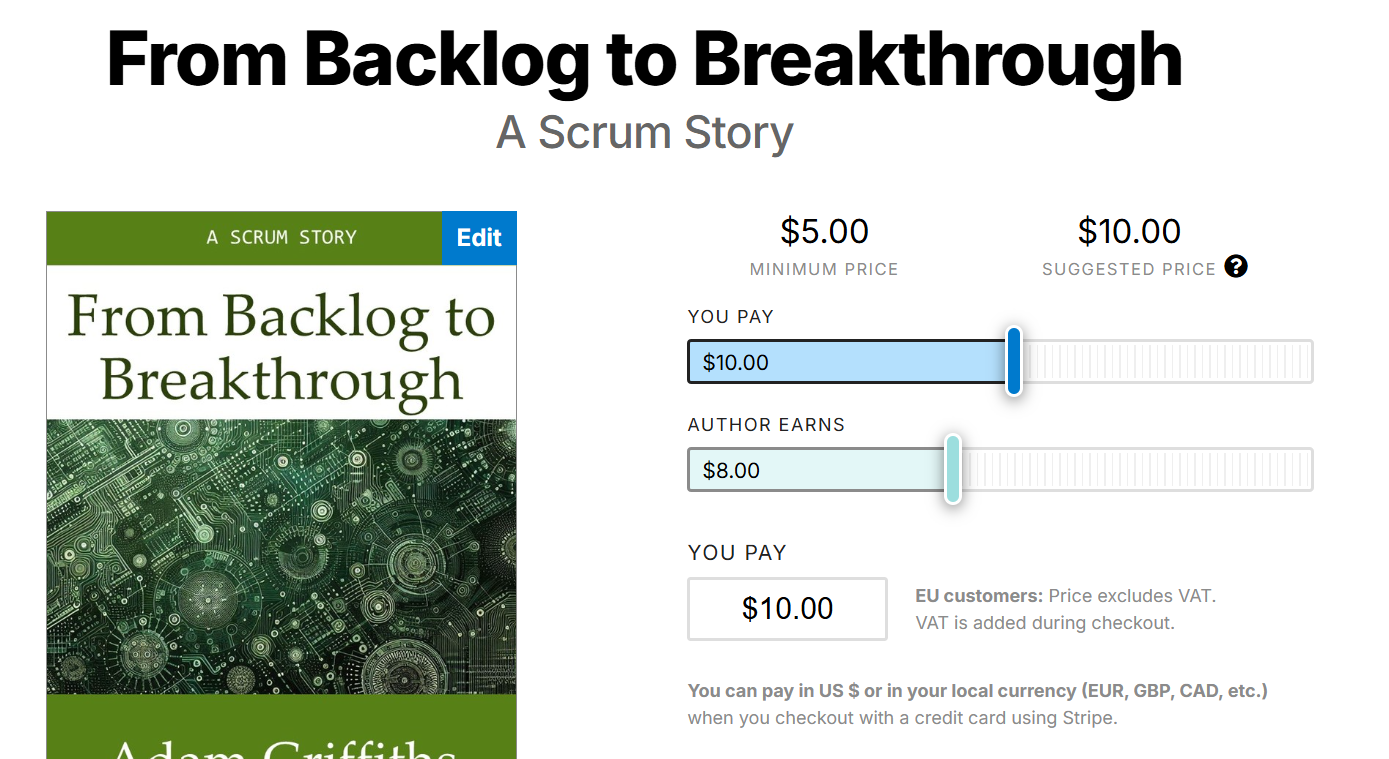
I’d love to hear your thoughts—whether about the book, the writing process, or your own experiences using AI creatively. Drop a comment below if you’d like to chat.







 dotdotdev.com